It’s All About Perspective
Every Manager Is Busy. The Difference Is What They Focus On First.
Stare at the ground in front of you.
Now lift your eyes and look toward the horizon.
Which view is better?
The answer depends on what you're trying to accomplish.
If you're hiking a trail, staring at the ground helps you avoid roots, rocks, and uneven footing. But if you spend the entire journey looking down, you may miss where you're actually headed and the view that surrounds you.
There is a significant difference between leadership theory and the reality of leading a team when everyone is looking to you for answers. My approach isn't built on academic concepts, but on 34 years of real-world experience navigating high expectations and the 'reactive cycle' of the modern workplace. I’ve learned that the strongest managers are those who can handle today’s rocks and roots without losing their view of the destination.
Many managers spend their days focused on what is directly in front of them. Emails. Meetings. Questions. Requests. Problems. Urgent issues that demand immediate attention.
These things matter.
But when they become your primary focus, they begin to shape your perspective. Over time, you can become so focused on managing today's work that you lose sight of where the team is actually going.
Leadership requires a different view.
It requires periodically lifting your eyes from the ground and looking toward the horizon. Not because today's work is unimportant, but because today's work should be moving the team toward something bigger.
A strategic priority.
A business objective.
A service improvement.
A stronger, more capable team.
Without that horizon, activity can easily be mistaken for progress.
Small Adjustments Create Big Outcomes
Imagine you're walking down a trail.
If you shift your direction by only a few degrees, the change feels almost insignificant in the moment. You are still moving forward. You are still on the same trail. You may not notice any difference at all.
But continue walking for an hour, a day, a month, or a year and the destination becomes dramatically different.
Leadership works the same way.
Most organizational improvements are not the result of a single major decision. They are the result of hundreds of small adjustments made consistently over time.
A clearer expectation.
A better delegation decision.
A stronger planning discussion.
A coaching conversation.
A process improvement.
A more deliberate communication strategy.
Individually, these adjustments may seem small. Collectively, they change everything.
Over the course of a year, those adjustments begin to show up in team performance, workload management, stakeholder relationships, employee confidence, and overall results. That movement does not happen by accident. It happens because a leader continues making deliberate course corrections while keeping the destination in sight.
Where Managers Start Their Day Matters
One of the most important lessons I learned as a manager is that the order in which you focus your attention matters.
Many managers begin their day with whatever is demanding attention the loudest. The overflowing inbox. The unexpected problem. The urgent request. The meeting that appeared overnight. The issue that someone else believes should become your issue.
This creates a reactive cycle. The day is consumed by responding rather than leading. Over time, the team's direction becomes increasingly influenced by urgency instead of priorities.
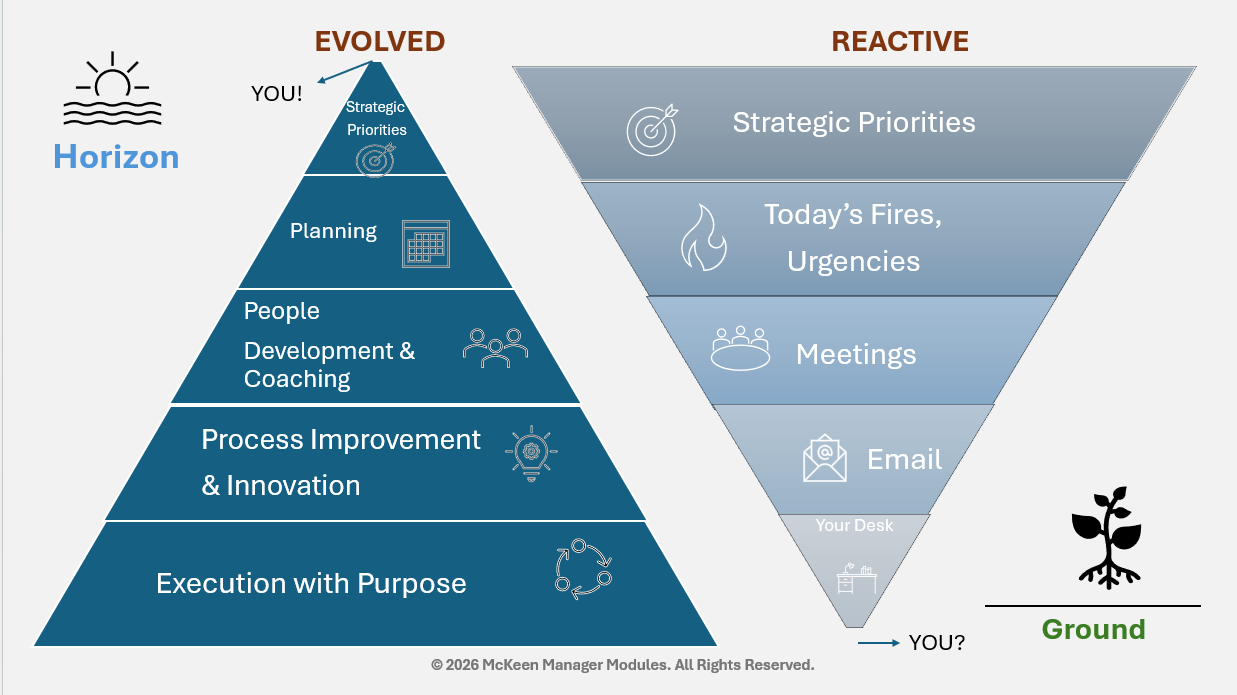
I often think of this as an upside-down pyramid (refer to blog image).
At the very top sits the organization's strategic priorities. Below that sits workload planning. Below that sits employee support, coaching, mentoring, and development. Below that sits the day-to-day operation of the team. Yet many managers spend the majority of their attention at the bottom of the pyramid, responding to whatever appears next. The work itself is not the problem. The order is.
When leaders intentionally reverse that perspective, everything begins to change. Strategic priorities become the starting point. Workload planning aligns with those priorities. Employee development supports the work that needs to be accomplished. Team operations reinforce the direction.
Daily issues are still addressed, but they no longer dictate the direction of the team. The tasks remain the same. The perspective changes.
Make Adjustments Visible
Another mistake many managers make is assuming their team automatically understands the adjustments being made. They don't.
A leader may spend time reconsidering priorities, changing direction, adjusting expectations, or refining plans. But if those adjustments remain inside the leader's head, the team continues operating under yesterday's assumptions. Leadership adjustments only create value when people can see them.
Communicate what is changing.
Explain why it matters. Connect the adjustment to the broader objective. Help people understand where the team is headed and how their work contributes to that destination.
Don’t forget that not everyone processes information the same way. Some people want direct instructions. Others need context. Some want data. Others want to understand the impact on people. Strong communication considers these differences while maintaining clarity about the objective.
Seeing the Horizon Is Only the Beginning
Many managers reach a point in their careers where they realize they can no longer lead exclusively through effort. Working harder isn't producing better results. Solving every problem personally isn't creating a stronger team. Attending more meetings isn't improving alignment.
At some point, leadership becomes less about managing the work directly and more about influencing the conditions that allow the work to succeed. That shift requires a different set of skills.
Strategic thinking.
Intentional communication.
Workload planning.
Influence.
Coaching.
Decision-making.
The ability to see beyond today's issues while still delivering today's results.
These are the capabilities that separate a reactive manager from an evolved leader. It's also the thinking that inspired the development of The Evolved Leader. Because leadership growth doesn't happen when managers learn to handle more work. It happens when they learn to see their work differently.
Lift Your Eyes
The next time you begin your day, pay attention to where your focus goes first.
Are you staring at the ground, consumed by the “reactive cycle” of emails and urgent requests?
Or are you looking toward the horizon?
After 34 years in the Federal Public Service, leading teams through high-pressure mandates and competing priorities, I’ve learned that the most effective leaders do both. They manage today’s realities while keeping tomorrow’s destination firmly in view. Leadership growth doesn’t happen when you learn to handle more work: it happens when you learn to see your work differently.
Where is your perspective today?
Choose the path that fits where you are:
Path 1: I need to build my foundation.
If you are currently feeling the "weight" of leadership, second-guessing your decisions, or simply trying to survive the first 90 days, you need a Leadership Operating System to replace the guesswork.
The Goal: Gain clarity, structure, and confidence in your day-to-day role.
The Solution: Enroll in Awaken Your Inner Leader— $99]
Path 2: I am ready to expand my impact.
If you have the basics down but feel like "working harder" is no longer the answer, it’s time to move from executing direction to shaping it. You are ready to think strategically and influence beyond your team boundary.
The Goal: Strengthen strategic thinking, influence upward, and lead with greater organizational impact.
The Solution: Explore The Evolved Leader